Go Back
Push Pull Legs Routine: The Complete Training Guide
Master the push pull legs routine. Discover the mechanics, choose your frequency, get a complete sample program, and track your split with a digital gym notebook.
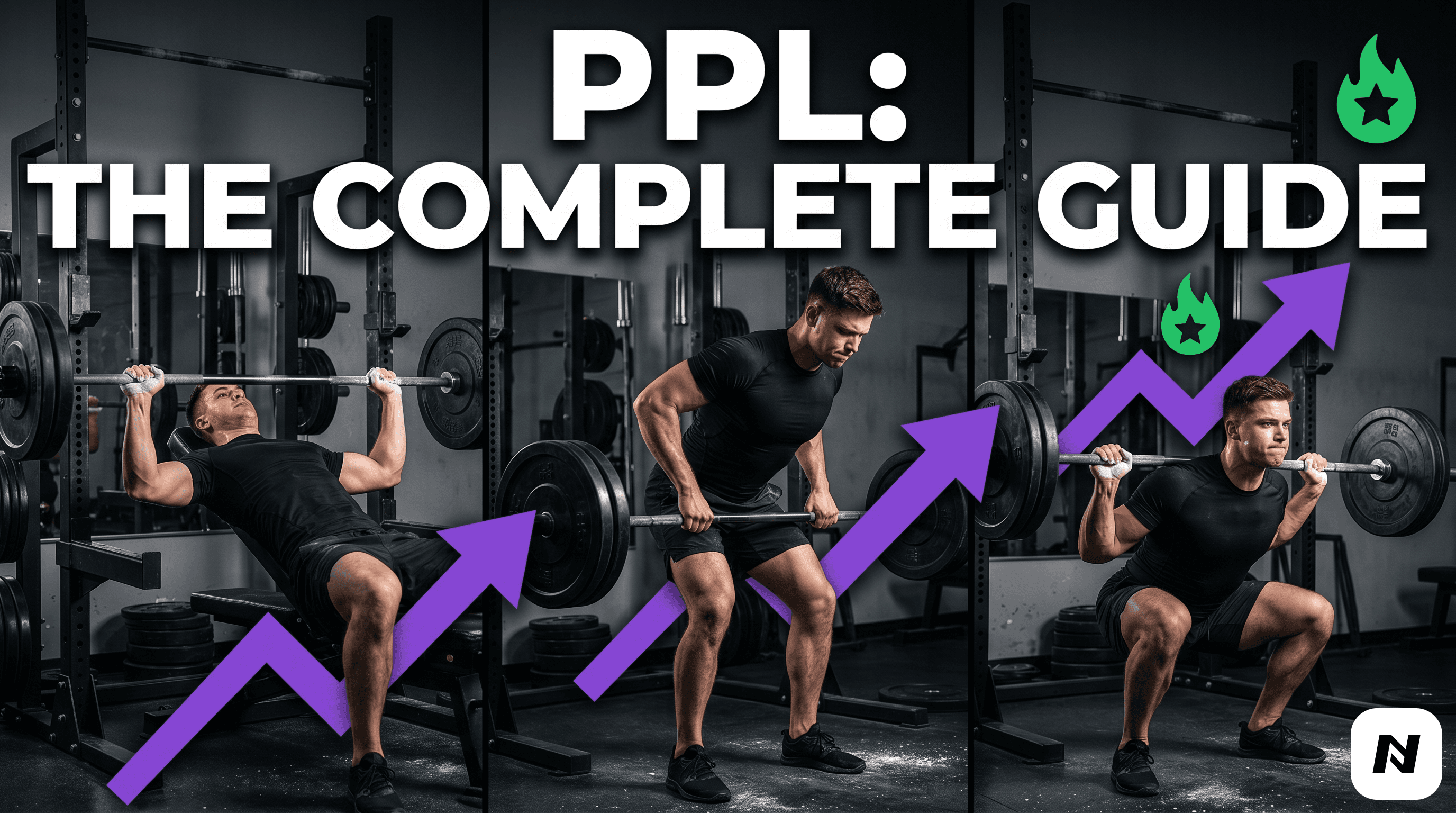
The Complete Guide to the Push Pull Legs (PPL) Routine
Walking into the gym without a plan is a waste of time. You end up doing a few random chest exercises, some bicep curls, and leaving. You get a pump, but you do not make progress.
Building muscle requires structure. It requires hitting the right muscles with the right volume, and then giving them time to recover.
Enter the Push Pull Legs (PPL) routine.
PPL is not a fad. It is the gold standard of training splits. It is used by beginners building their foundation and advanced bodybuilders stepping on stage. It groups your muscles by their biomechanical function, ensuring maximum effort in the gym and maximum recovery at home.
If you want to stop guessing and start growing, this is your blueprint. Here is the complete breakdown of the push pull legs routine, how to structure your week, a full sample program, and how to manage the numbers without losing your mind.
What is the Push Pull Legs Routine?
Most traditional training programs (like the classic "bro-split") assign one body part to one day. You have a Chest Day, a Back Day, and an Arm Day.
The Push Pull Legs split does not care about individual body parts. It cares about movement patterns. It divides your body into three distinct functional categories:
Push: Any exercise where you are pushing weight away from your torso.
Pull: Any exercise where you are pulling weight toward your torso.
Legs: Any exercise that involves the lower body.
By grouping exercises this way, you eliminate overlap. When you train your chest, your triceps naturally assist the movement. In a PPL split, you train them together. This guarantees that when your push muscles are working, your pull muscles are completely resting.
Why PPL is the Gold Standard
Why has this specific split survived decades of fitness trends? Because it aligns perfectly with human physiology.
Optimal Muscle Frequency
Science shows that training a muscle group twice a week is optimal for hypertrophy (muscle growth). A traditional body-part split hits a muscle once every seven days. That is too much rest. A 6-day PPL routine hits every single muscle group twice a week, doubling your growth opportunities.
Perfect Recovery Windows
Muscle is not built in the gym. It is built in bed and in the kitchen. PPL organizes your training so that no muscle is worked on consecutive days. Your chest, shoulders, and triceps get a full 48 to 72 hours to rebuild before you push again.
High Adaptability
PPL scales with your experience. A beginner can run it three days a week. An intermediate lifter can run it six days a week. You can swap exercises based on the equipment available, your injury history, or your specific weak points. It is a framework, not a prison.
Breaking Down the Split
To build a massive, balanced physique, you need to understand exactly what happens on each day of the cycle.
Push Day
Target Muscles: Pectorals (Chest), Anterior Deltoids (Front Shoulders), Lateral Deltoids (Side Shoulders), Triceps.
Push day is entirely upper body. The focus is on pressing movements. You start with heavy compound lifts like the barbell bench press or the overhead press. These exercises recruit multiple muscle groups and allow you to move the most weight.
Once the heavy compounds are done, you move to isolation exercises. You hit the side delts with lateral raises. You fry the triceps with cable pushdowns. By the end of the session, every pushing muscle is exhausted.
Pull Day
Target Muscles: Latissimus Dorsi (Lats), Rhomboids, Trapezius (Traps), Posterior Deltoids (Rear Shoulders), Biceps, Forearms.
Pull day builds a thick, wide back. It heavily taxes your grip. You will alternate between vertical pulls (like pull-ups and lat pulldowns) to build width, and horizontal pulls (like barbell rows and cable rows) to build thickness.
Your biceps are heavily involved in every back exercise. Once your back is fatigued, you finish the workout by isolating the biceps with curls to maximize the pump and force adaptation.
Legs Day
Target Muscles: Quadriceps, Hamstrings, Glutes, Calves.
Leg day is brutal. It requires the most energy, creates the most systemic fatigue, and yields the biggest metabolic response.
You focus on the squat and the hinge. Heavy barbell squats or leg presses target the quads and glutes. Romanian deadlifts or leg curls target the hamstrings. You finish with calf raises. Because the lower body contains the largest muscles in your body, Leg Day dictates your overall recovery.
Choosing Your Frequency: 3-Day vs. 6-Day
The PPL framework is flexible. You must choose a frequency that matches your life schedule and your physical recovery capacity.
The 3-Day Split (Beginners)
If you are new to lifting, or if you play other sports, three days a week is perfect.
Monday: Push
Tuesday: Rest
Wednesday: Pull
Thursday: Rest
Friday: Legs
Weekend: Rest
This provides ample recovery. You are not hitting muscles twice a week, but the intensity per session can be incredibly high because you are always fresh.
The 6-Day Split (Intermediate/Advanced)
If you want maximum muscle growth and have the time, the 6-day split is the ultimate protocol.
Day 1: Push
Day 2: Pull
Day 3: Legs
Day 4: Push
Day 5: Pull
Day 6: Legs
Day 7: Rest
This is a heavy workload. You hit every muscle twice a week. To survive this, you must eat enough food and get enough sleep.
Most lifters who run a 6-day split use two different workouts for each category (Push A and Push B). This allows you to prioritize the chest on Day 1, and prioritize the shoulders on Day 4, preventing overuse injuries.
The Complete 6-Day PPL Sample Program
Here is a balanced, highly effective 6-day Push Pull Legs template. It uses the "A/B" format to ensure you hit muscles from every angle.
Push A (Chest Focus)
Barbell Bench Press: 3 sets x 5-8 reps (Heavy compound)
Incline Dumbbell Press: 3 sets x 8-12 reps
Seated Dumbbell Overhead Press: 3 sets x 8-12 reps
Cable Lateral Raises: 4 sets x 12-15 reps
Overhead Tricep Extension: 3 sets x 10-14 reps
Tricep Rope Pushdown: 3 sets x 10-14 reps
Pull A (Vertical Focus)
Pull-Ups (or Lat Pulldown): 3 sets x 6-10 reps
Barbell Row: 3 sets x 8-12 reps
Face Pulls: 3 sets x 15-20 reps (Rear delts and trap health)
Dumbbell Hammer Curls: 3 sets x 10-12 reps
EZ Bar Bicep Curls: 3 sets x 10-12 reps
Legs A (Squat Focus)
Barbell Back Squat: 3 sets x 5-8 reps
Romanian Deadlift (RDL): 3 sets x 8-12 reps
Leg Press: 3 sets x 10-15 reps
Seated Leg Curls: 3 sets x 10-15 reps
Standing Calf Raises: 4 sets x 12-20 reps
Push B (Shoulder Focus)
Standing Overhead Barbell Press (OHP): 3 sets x 5-8 reps
Close-Grip Bench Press: 3 sets x 8-12 reps
Incline Machine Press (or Cable Crossovers): 3 sets x 10-15 reps
Dumbbell Lateral Raises: 4 sets x 12-15 reps
Skullcrushers: 3 sets x 8-12 reps
Pull B (Horizontal Focus)
Chest-Supported Row: 3 sets x 8-12 reps
Close-Grip Lat Pulldown: 3 sets x 8-12 reps
Single Arm Dumbbell Row: 3 sets x 10-12 reps
Reverse Pec Deck (Rear Delts): 3 sets x 12-15 reps
Incline Dumbbell Curls: 3 sets x 10-12 reps
Legs B (Hinge/Press Focus)
Hack Squat (or Front Squat): 3 sets x 8-12 reps
Leg Extensions: 3 sets x 12-15 reps
Lying Leg Curls: 3 sets x 10-15 reps
Bulgarian Split Squats: 3 sets x 8-12 reps per leg
Seated Calf Raises: 4 sets x 12-20 reps
Managing the Split: Ditch the Paper
Look at the program above. It contains dozens of exercises, varying rep ranges, and rotating focuses.
If you try to track a 6-day PPL routine with a paper notebook, you will fail. You will spend half your workout flipping through pages trying to remember what you benched last Monday on "Push A" versus what you did on Thursday for "Push B."
Managing a multi-day split requires a dedicated, organized tool.
This is exactly why we built Nouta. A digital gym notebook removes the friction from complex programming.
Build Your Templates Once
With Nouta, you do not recreate your workout every time you walk into the gym. You use the Templates/Plans feature.
You sit on your couch, open the app, and build Push A, Pull A, Legs A, Push B, Pull B, and Legs B. You save them. That is it. The heavy lifting of programming is done.
When you get to the gym, you just select today's template. The app instantly pulls up your exercises, recalls your exact weights from the previous week, and runs your routine on autopilot. You focus entirely on the barbell.
Share and Copy Workouts
PPL is the most common routine for training partners. But keeping two people synchronized on a 6-day split is tough.
Nouta makes it seamless. Once you build your perfect PPL template, you can use the share/copy workouts feature. With a few taps, you send the entire routine to your lifting partner. They import it into their own Nouta app instantly. You are both running the exact same programming, tracking your own individual PRs, and pushing each other to get stronger through the social feed.
Stay Focused with Dark Mode
A gym app should not look like a social media feed. Nouta features a sleek dark mode. It is easy on your eyes under harsh gym lighting, saves battery life, and keeps distractions to an absolute minimum. Log your set, put the phone down, and rest.
Progression: Making the Routine Work
A routine is just a list of exercises. What makes your muscles grow is progressive overload.
You must force your body to adapt. Every time you repeat a workout in your PPL cycle, you must try to beat your previous performance.
Use the double progression method:
Pick a rep range: For example, 8 to 12 reps on the Incline Dumbbell Press.
Hit the top of the range: Lift a weight until you can successfully complete 3 sets of 12 reps.
Increase the weight: The next time you do Push A, grab the next heaviest dumbbells. Your reps will likely drop back down to 8.
Repeat: Work your way back up to 12 reps.
Nouta tracks this automatically. Every time you log a set, it checks your history. When you successfully push more weight or hit more reps, the app hits you with digital PR confetti. You know exactly when you are making progress.
Do Not Ignore Recovery
A 6-day PPL will humble you. It is a massive amount of volume.
If you attempt this split while sleeping five hours a night and undereating protein, you will not build muscle. You will burn out. Your joints will ache. Your lifts will stall.
Eat Protein: Aim for 0.8 to 1 gram of protein per pound of body weight.
Sleep: Get 7 to 9 hours of quality sleep. This is when human growth hormone is released.
Deload: Every 6 to 8 weeks, take a deload week. Cut your weights or your total volume in half. Let your central nervous system recover.
Execute the Plan
The Push Pull Legs routine is foolproof. If you put in the effort, lift with intensity, and eat enough food, you will get stronger. You will build an impressive physique.
But you have to keep track of the numbers. Stop guessing your weights. Stop walking into the gym without a plan. Build your templates, log your PRs, and watch your progress charts climb.
FAQ: The Push Pull Legs Split
Can I put deadlifts in a PPL routine? Yes, but they require careful placement. Traditional barbell deadlifts are incredibly taxing on both the back and the legs. Most lifters put them on Pull Day (treating them as a back exercise) or Legs Day. If you deadlift, lower the volume on your other heavy compound movements that day.
How long should a PPL workout take? A standard PPL session should take between 45 and 75 minutes. If it takes longer than 90 minutes, you are resting too long between sets or doing too much junk volume.
What if I miss a day in the 6-day cycle? Do not panic. Just pick up exactly where you left off. If you miss Pull Day on Tuesday, do Pull Day on Wednesday. The days of the week do not matter; the sequence of the workouts matters.
Is PPL good for fat loss? Yes. Fat loss is driven by a caloric deficit (eating less than you burn). PPL is a resistance training routine designed to build or preserve muscle. Running PPL while in a caloric deficit will help you retain muscle mass while you lose body fat.
Build your plan. Run it on autopilot. Create your custom PPL templates, track your PRs, and share your routine with your friends.
Download Nouta for free today.