Go Back
First 30 Days: The Ultimate Beginner Gym Routine
Survive your first month lifting. Learn why building a consistent beginner gym routine matters more than perfect workouts, and how to track it simply.
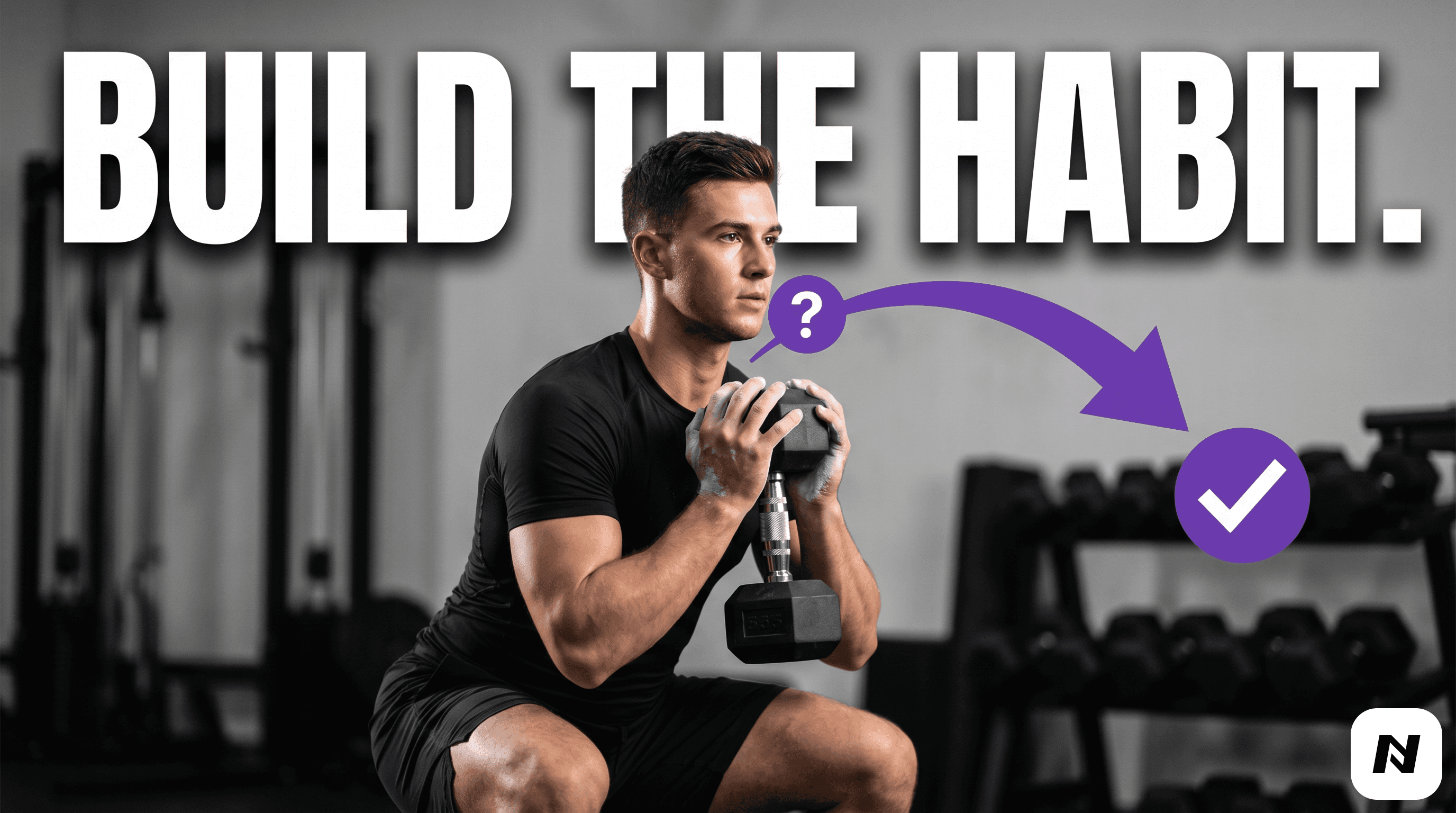
The First 30 Days: How to Build a Lifting Habit That Lasts
Most people quit the gym within the first month. They go too hard on day one. They wake up incredibly sore, skip day two, and by week three, they stop showing up entirely.
You will not do this.
Your goal for the first 30 days is simple. You are not trying to build massive biceps. You are not trying to set a world record on the squat. You are not trying to master the perfect, biomechanically optimal lifting technique.
You are trying to build a habit.
The first month is about survival and consistency. It is about proving to yourself that you can show up three days a week, every single week. If you can lock in the habit now, the muscle and strength will inevitably follow. Here is exactly how to survive your first 30 days in the gym and build a foundation for life.
The Trap of "Optimal" Lifting
Beginners read too much. You scroll through fitness content and see advanced bodybuilders arguing over the exact angle of a cable fly. You see powerlifters debating the intricacies of a deadlift setup.
This information is useless to you right now.
Trying to build the perfect, mathematically optimal beginner gym routine will paralyze you. Optimization is for people who have already mastered the basics. Right now, your only job is execution. Consistency always beats perfection.
It does not matter if your squat depth is slightly off during your first week. It does not matter if you use dumbbells instead of a barbell for your chest press. What matters is that you perform the movement safely, log the weight, and come back two days later to do it again. Drop the obsession with perfection. Embrace the process of simply doing the work.
Why You Need a Rigid Beginner Gym Routine
The biggest driver of gym anxiety is the unknown.
When you walk into a crowded weight room without a plan, you panic. You wander past the treadmills. You stare at the racks of dumbbells. You wait for a machine to open up, do a few half-hearted sets, feel awkward, and leave. You just wasted your time.
A strict beginner gym routine removes decision-making. Decision fatigue kills momentum. When you know exactly what exercises to do, how many sets to complete, and how many reps to aim for, the anxiety vanishes. You do not have to think. You just look at your plan and execute. This lowers the barrier to entry and builds your confidence on the gym floor.
The 3-Day Full Body Blueprint
For your first 30 days, keep it extremely simple. Train three days a week. Monday, Wednesday, and Friday is the standard split. Rest on the days between.
Focus entirely on compound movements. Compound exercises are movements that use multiple joints and muscle groups at the same time. Think squats, presses, and rows. They give you the highest return on your time investment.
Here is an example of a foolproof beginner gym routine:
Workout A:
Goblet Squats: 3 sets of 10 reps
Dumbbell Bench Press: 3 sets of 10 reps
Seated Cable Rows: 3 sets of 10 reps
Dumbbell Bicep Curls: 2 sets of 12 reps
Workout B:
Leg Press: 3 sets of 10 reps
Dumbbell Shoulder Press: 3 sets of 10 reps
Lat Pulldowns: 3 sets of 10 reps
Tricep Pushdowns: 2 sets of 12 reps
Alternate these two workouts every time you go to the gym. Do Workout A on Monday. Do Workout B on Wednesday. Do Workout A again on Friday. The following week, start with Workout B.
The Rules of the First Month
Having a routine is step one. Step two is following a strict set of behavioral rules to ensure you do not burn out. Adhere to these three principles for the next 30 days.
Rule 1: Leave Your Ego at the Door
Start lighter than you think you need to.
If you are using a barbell, start with just the empty bar. If you are using dumbbells, pick up the 10-pound or 15-pound weights. Your muscles might be strong enough to lift more, but your connective tissues, joints, and nervous system are not used to the load.
Lifting too heavy in your first week leads to severe Delayed Onset Muscle Soreness (DOMS). A little soreness is normal. Debilitating soreness that prevents you from walking up stairs is a mistake. It will force you to skip your next workout, breaking the habit loop. Start incredibly light. Add 5 pounds next time.
Rule 2: Stop Changing Your Program
Program hopping is the enemy of progress.
You will get bored doing the same 6 to 8 exercises every week. You will be tempted to try a new machine or copy a crazy workout you saw online. Do not do it.
You cannot measure progress if you are constantly changing the variables. You need to stick to the exact same beginner gym routine for at least 30 days. This repetition teaches your nervous system how to perform the movements efficiently. It is called neurological adaptation, and it is responsible for the rapid strength gains you will experience in your first month.
Rule 3: Track Every Single Set
Memory is a liar. You will not remember what weight you used for the shoulder press last Tuesday. If you do not know what you lifted last time, you do not know what to lift today.
You must track your workouts. This is non-negotiable.
Writing down your numbers serves two purposes. First, it dictates your progressive overload—the process of gradually adding weight or reps over time. Second, it provides a massive psychological reward. When you see your numbers go up on paper, your brain releases dopamine. This reward reinforces the habit of going to the gym.
How Templates Save You From Overwhelm
Bringing a physical paper notebook to the gym is clunky. Using a complicated, cluttered spreadsheet on your phone is incredibly frustrating. You spend more time zooming in on tiny cells than you do lifting weights.
You need a tool that stays out of your way. This is where a digital gym notebook changes the experience for beginners.
Instead of walking into the gym and trying to remember Workout A, you use pre-built templates. You set up your routine at home. When you step onto the gym floor, you tap the template once. Your entire workout is pre-loaded on your screen. You do the set. You tap the weight and the reps. You rest.
It strips away all the friction. You focus entirely on the physical effort, not the administrative work of formatting a logbook.
Expectation Management: The 30-Day Timeline
Knowing what to expect physically and mentally will prevent you from quitting when things feel difficult. Here is the reality of your first 30 days.
Week 1: The Shock Phase Everything feels awkward. The weights feel unsteady. You will feel self-conscious. You will be sore for two days after every workout. Push through it. The soreness is temporary.
Week 2: The Adaptation Phase The crippling soreness fades into a dull ache. You start to recognize the equipment. The movements feel slightly more natural. You realize that nobody in the gym is actually watching you or judging you. Everyone is focused on their own workout.
Week 3: The Routine Phase You no longer have to look up how to perform a seated row. You know the setup. The anxiety of walking through the front doors is gone. Going to the gym simply becomes a thing you do, like brushing your teeth.
Week 4: The Progression Phase This is where the magic happens. You look at your gym notebook and realize you are lifting 10 to 15 pounds more than you were on day one. Your clothes fit slightly differently. Your energy levels throughout the day are higher. The habit is locked in.
Lock In Your Habit Today
You do not need massive amounts of free time or elite genetics to get in shape. You just need discipline and the right tools.
Stop wandering the gym floor. Stop guessing your next exercise. Build a simple, repeatable beginner gym routine. Keep your workouts short, focus on the big compound movements, and track your data instantly so you can get in, do the work, and get out.
With a dedicated digital gym notebook, you take complete control of your fitness journey from day one.
Download Nouta for free today, set up your first template, and build the lifting habit for good.
FAQs About Starting at the Gym
How long should my workouts last? As a beginner, your workouts should take between 45 and 60 minutes. If you are in the gym for two hours, you are either resting too long or trying to do too many exercises. Keep it dense and efficient.
What if I miss a workout day? Do not panic and do not try to punish yourself by doing double the work the next day. If you miss a Wednesday workout, simply pick up where you left off on Thursday or Friday. Consistency is about the long-term average, not a perfect streak.
Do I need to take supplements right away? No. Supplements like creatine and pre-workout are entirely optional and unnecessary for your first 30 days. Focus on eating whole foods, drinking plenty of water, and getting adequate sleep. Master the basics before spending money on powders.
Should I do cardio or lift weights first? If your primary goal is to build muscle and strength, always lift weights first. Weightlifting requires high energy and neurological focus. If you exhaust yourself on the treadmill for 30 minutes, your lifting routine will suffer. Do cardio after your weights, or on your rest days.