Go Back
How to Track Progressive Overload (The Simple Way)
Learn exactly how to track progressive overload at the gym. Master double progression, what to log, and how a free gym notebook guarantees your progress.
How to Track Progressive Overload at the Gym
Memory is a terrible gym partner.
You walk up to the squat rack. You load the bar. You think you did 225 pounds for eight reps last week. Or was it seven? Maybe it was 215 pounds. You guess, you lift, and you leave.
Weeks pass. Your body looks the same. Your lifts stay the same.
This happens because you are missing the single most important rule of lifting: progressive overload. To force your muscles to grow and get stronger, you have to subject them to more stress than they experienced last time. If you do not know exactly what you did last time, you cannot beat it this time.
You need a system. You need to track your workouts. Here is exactly how to track progressive overload at the gym, what numbers actually matter, and how a simple gym notebook guarantees your progress.
What is Progressive Overload?
Your body is lazy. It only builds muscle when it is forced to.
When you lift a weight that challenges you, your body registers that stress as a threat. It responds by rebuilding your muscle fibers slightly bigger and stronger so they can handle that exact stress easily next time.
If you go back to the gym and lift the exact same weight for the exact same number of reps, your body has no reason to change. It is already adapted to that workload. To trigger new growth, you have to increase the demand. You have to overload the system.
You can achieve progressive overload in several ways:
Lifting more weight for the same number of reps.
Lifting the same weight for more reps.
Doing more sets of a given exercise.
Improving your form while lifting the same weight and reps.
Tracking these variables takes the guesswork out of your training. It gives you a clear target to beat every time you step foot in the gym.
Exactly What to Log Every Session
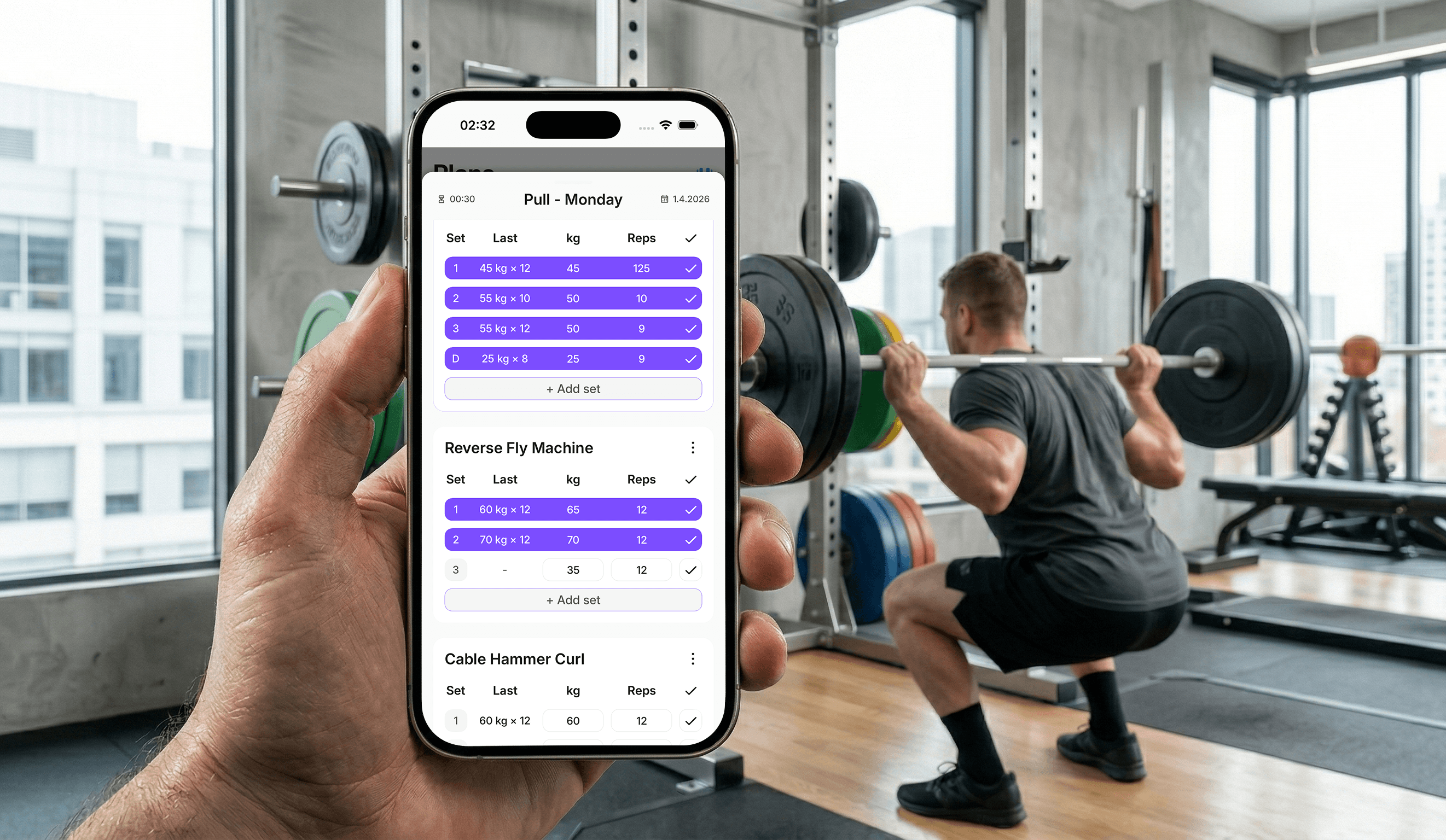
Tracking your workouts does not need to be complicated. You do not need spreadsheets. You just need a reliable gym notebook. If you want to keep things simple, use a digital tracker. A free app like Nouta keeps your data safe, does the math for you, and has a dark mode so you aren't blinded by your screen between sets.
To track progressive overload properly, you must log four specific variables for every single exercise.
1. The Exercise Name
Consistency is mandatory. You cannot track progressive overload if you change your exercises every week to "confuse the muscles." Pick a routine. Build a template. Stick to the same exercises for at least eight to twelve weeks. Your gym notebook should have your routine locked in before you even walk through the gym doors.
2. The Weight Used
Log the exact weight you used for every working set. Do not round up. Do not ignore the fractional plates. If you used 135 pounds, write down 135. If you used the machine pin on slot number six, write down slot six. Accuracy is your best friend.
3. Sets and Reps
Every single rep counts. Do not just write down "3 sets of 10." If your first set was ten reps, your second set was nine, and your third set was seven, you need to log: 10, 9, 7.
When you look at your log next week, your goal might simply be to turn that 10, 9, 7 into 10, 10, 8. That single extra rep is progressive overload. Without accurate logging, you would never spot that victory.
4. RPE or RIR (Optional but Recommended)
RPE stands for Rate of Perceived Exertion (a scale of 1 to 10). RIR stands for Reps in Reserve (how many more reps you could have done before failing).
Logging how hard a set felt helps contextualize your data. If you hit 225 pounds for five reps, but your notebook says your RIR was zero (absolute failure), you know you should not add weight next week. If your RIR was three, you know you have room to load more weight on the bar.
Simple Rules for Adding Weight and Reps
Knowing what to log is only half the battle. You also need to know when to push harder. You need a progression model. Here are the two simplest ways to force growth.
The Double Progression Method
This is the gold standard for muscle growth. It is simple, effective, and self-regulating.
Instead of aiming for a fixed number of reps, you aim for a rep range. Let’s say your target for the Dumbbell Bench Press is 3 sets of 8 to 12 reps.
Pick a weight you can lift for at least 8 reps, but no more than 12. Let's say you pick 50-pound dumbbells.
Your first week, you might log: 10 reps, 9 reps, 8 reps.
Your goal next week is to add reps using the exact same weight.
You keep tracking and adding reps until you hit 12 reps on all 3 sets (12, 12, 12).
Once you hit the top of the rep range, you increase the weight to 55-pound dumbbells.
Your reps will naturally drop back down (maybe to 8, 8, 7).
You repeat the cycle.
You progress the reps first, then you progress the weight. Double progression. A dedicated gym notebook makes this incredibly easy to follow. You just check your last session, see if you hit the top of your rep range, and grab your dumbbells accordingly.
Linear Progression
Linear progression is best for beginners and heavy compound lifts (like squats, deadlifts, and barbell bench presses).
The rule is straightforward: Add a small amount of weight to the bar every single session. If you squatted 185 pounds for 3 sets of 5 reps this week, you put 190 pounds on the bar next week. You keep adding weight linearly until you can no longer hit your target reps.
Form Over Ego
Progressive overload only works if your technique remains consistent. If you add ten pounds to your squat, but you only go down half as far, you did not achieve progressive overload. You just cheated the range of motion. Only increase the weight or reps if you can maintain strict, controlled form.
How Charts and PRs Reveal Your True Trends
Fitness is not a straight line. Some days you sleep poorly. Some days you are stressed. Your performance will fluctuate.
If you only look at your workouts day by day, a bad session can ruin your motivation. This is where visualizing your data becomes a game-changer. Staring at pages of handwritten numbers makes it hard to see the big picture. Using a digital gym notebook turns those numbers into clear, undeniable trends.
When you log your workouts consistently, your app generates progress charts. You can look at a chart of your overhead press over the last six months. Even if last Tuesday was a weak day, the chart will show the line moving steadily upward over time.
Furthermore, a digital tracker automatically alerts you when you hit a Personal Record (PR). Hitting a PR—whether it is a one-rep max, a new volume record, or finally getting 10 reps with a weight that used to crush you—is the ultimate proof of progressive overload. Seeing those digital confetti moments validates your hard work. It builds momentum. It makes the grind addictive.
What About Deloads?
Eventually, you will hit a wall. When adding weight or reps becomes impossible for a few weeks, or your joints ache constantly, it is time for a deload. A deload is a brief period—usually one week—where you intentionally reduce your lifting volume or intensity by about thirty to fifty percent to allow your central nervous system and muscles to fully recover. You are not losing gains during this week; you are clearing fatigue so you can return the following week primed to smash through your plateau and resume your progressive overload trajectory.
Common Tracking Mistakes to Avoid
Even with the best intentions, lifters often sabotage their own progressive overload. If you are logging your workouts but not seeing progress, check your habits against these common errors.
Mistake 1: Relying on Memory We already covered this, but it bears repeating. You will not remember what you lifted three weeks ago. Logging your sets in the parking lot after you leave is just as bad. Log your sets immediately after you finish them. Open your gym notebook, input the data, and rest.
Mistake 2: Program Hopping Progressive overload requires a baseline. You cannot track progress on a barbell squat if you constantly swap it out for hack squats, leg presses, and lunges. Find a solid template. Stick to it. Run the program until you milk every ounce of progress out of it.
Mistake 3: Chasing Weight at the Expense of Everything Else Progressive overload is not just about adding plates to the bar. If your form breaks down, you are robbing the target muscle of tension and risking injury. Improving your tempo, pausing at the bottom of a rep, or getting a deeper stretch with the exact same weight is also progressive overload.
Consistency Beats Complexity
You do not need a complicated spreadsheet to build a great physique. You do not need to do complex math between sets. You just need a reliable system that tells you exactly what you need to do to be better than last time.
The secret to getting stronger is boring, unglamorous consistency. It is showing up, opening your gym notebook, checking last week's numbers, and fighting for one more rep.
Every session is a chance to beat your past self. But to win that fight, you have to keep score.
FAQ: Progressive Overload Tracking
How often should I increase the weight? Increase the weight only when you hit the top of your target rep range for all prescribed sets with excellent form. This could happen every week for beginners, or every few weeks for advanced lifters.
Should I track warm-up sets? Generally, no. Your gym notebook should focus on your "working sets"—the sets that are challenging and directly contribute to progressive overload.
What if I fail to beat my last workout? Do not panic. Progress is never perfectly linear. If you fail to improve for one week, try again next week. If you stall for three weeks in a row, consider a deload or check your sleep and nutrition.
Is a digital tracker better than paper? Paper works, but a digital gym notebook is vastly superior. Apps do not get sweat-stained, they automatically calculate volume, they track PRs instantly, and they generate charts to show you long-term trends without any manual math.
Stop guessing your numbers. Start tracking your progress. Get the clarity you need to actually grow. Keep it simple, see your PRs, and connect with friends.