Go Back
How to Test 1RM Safely: Math, Warm-Ups, and Maxing Out
Learn exactly how to test your 1RM safely. Master the perfect warm-up protocol, calculate your weight jumps, and track your massive new PRs for free.
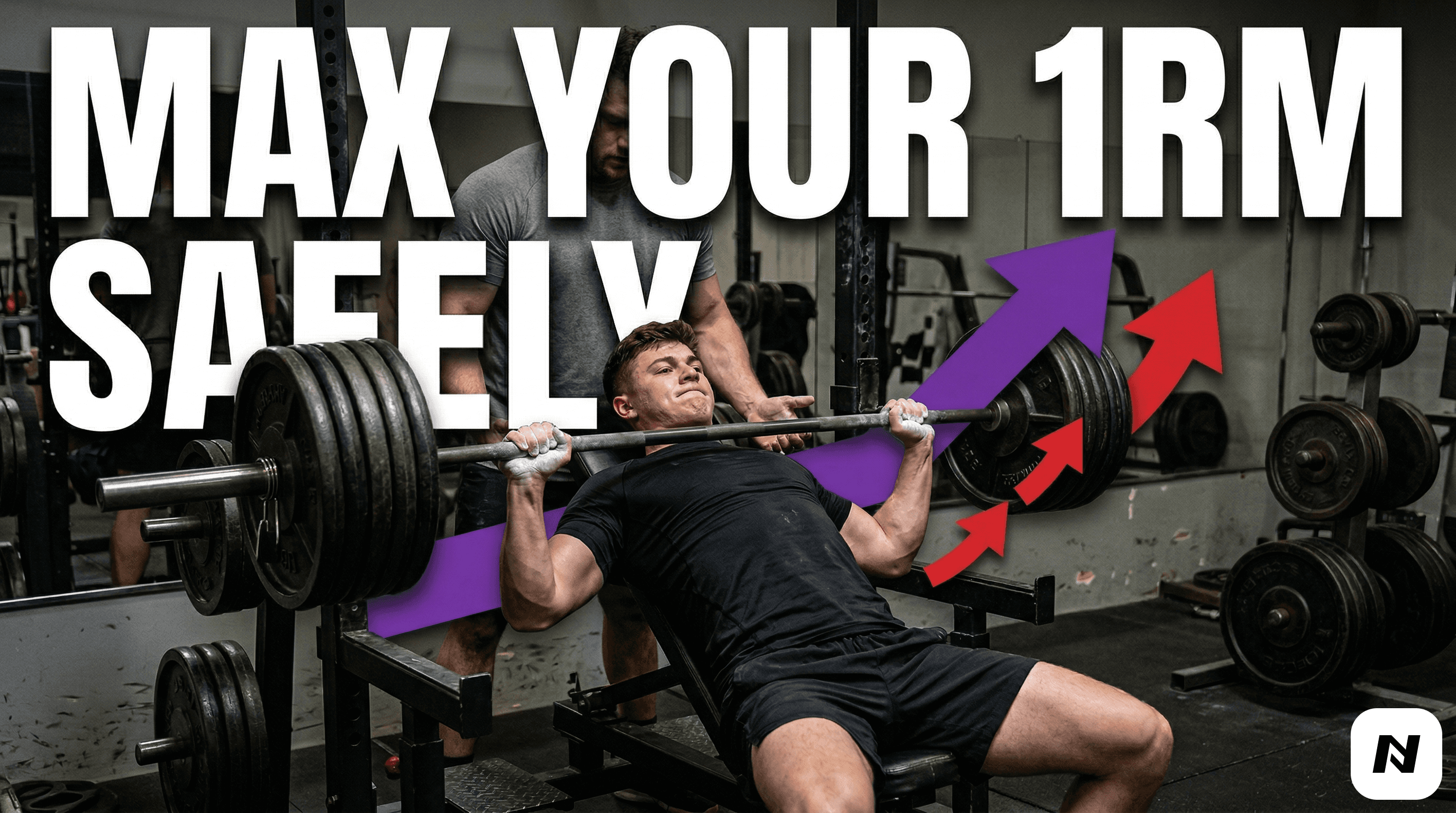
How to Test Your 1 Rep Max (1RM)
The barbell is loaded. The gym is loud. You are staring down the heaviest weight you have ever attempted to lift.
Your 1 Rep Max (1RM) is the ultimate test of your strength. It is the maximum amount of weight you can lift for a single, unassisted repetition with perfect form. Hitting a new PR is the most addictive feeling in fitness.
But maxing out is a skill. You cannot just walk into the gym, throw plates on the bar, and hope for the best. Testing your 1RM without a plan is a quick way to miss a lift, ruin your confidence, or tear a muscle.
You need a strategy. You need to prepare your nervous system, calculate your jumps, and prioritize safety. Here is the practical guide on how to test your 1RM safely, execute the perfect warm-up, and log your new baseline.
Why Test Your 1RM?
Testing your max is not just an ego boost. It serves a vital training purpose.
Many high-quality workout templates and strength programs are percentage-based. They tell you to lift 75% of your 1RM for five reps, or 85% for three reps. If you do not know your true 1RM, you are just guessing your working weights.
Testing your max gives you absolute clarity. It sets a concrete baseline. Once you know your true limits, you can program your future workouts with precision.
The Golden Rule: Safety First
Before we discuss the math, we must discuss the risk. A 1RM attempt subjects your bones, joints, and central nervous system to immense stress. You are operating at your absolute physical limit. You must mitigate the risk.
Always Use Spotters
Never attempt a 1RM bench press or barbell squat alone. Period.
Ask for a spotter. Tell them exactly what you are doing. Tell them how many reps you are attempting (just one). Tell them exactly when to help. A good rule for spotting is: "Do not touch the bar unless it starts moving downward."
Set the Safety Pins
If you are squatting or benching in a power rack, set the safety pins. Set them just below the lowest point of your range of motion. If you fail the lift and the spotter cannot pull it off you, the pins will save you from being crushed. Take sixty seconds to adjust the rack. It is non-negotiable.
Do Not Sacrifice Form for Ego
A 1RM is a heavy lift, so slight form breakdown is common. But massive form breakdown is dangerous. If your back rounds completely on a deadlift, or your hips shoot two feet off the bench press pad, the lift does not count. You did not get stronger; you just cheated the mechanics. Keep your form tight.
The Math: Estimating Your Target
To plan your 1RM test, you need to know what number you are aiming for. You need an educated guess.
Look at your gym notebook. Check your recent training logs. Find a heavy set where you lifted a weight for 3 to 5 challenging reps. You will use this data to estimate your max using the Epley formula.
The formula is: Weight × (1 + (0.0333 × Reps))
Let's simplify that. For every rep you can do with a given weight, add roughly 3.3% to the total weight.
An Example: Last week, your digital log says you benched 225 pounds for 5 hard reps.
225 lbs × 5 reps = 1125
1125 × 0.0333 = 37.4 lbs
225 lbs + 37.4 lbs = 262.4 lbs.
Your estimated 1RM is roughly 260 to 265 pounds.
This is your target. You will build your entire warm-up and attempt strategy around this specific number.
The Perfect 1RM Warm-Up Protocol
A proper warm-up makes or breaks a 1RM test.
Your central nervous system (CNS) controls your muscle fibers. It needs to be awakened and primed for maximal effort. However, your muscles run on limited fuel. If you do too many reps during your warm-up, you build lactic acid. You accumulate fatigue. By the time you reach your top weight, your muscles are already exhausted.
The goal is to prime the CNS with heavy weight, but keep the total reps incredibly low to avoid fatigue.
Assuming your target 1RM is 265 pounds, here is the perfect warm-up sequence:
The Empty Bar: 2 sets of 10 reps. Focus strictly on perfect technique and greasing the groove.
50% of Target (135 lbs): 1 set of 5 reps. Move the bar fast.
70% of Target (185 lbs): 1 set of 3 reps. Brace your core hard.
80% of Target (210 lbs): 1 set of 2 reps. This should feel moderately heavy, but very smooth.
90% of Target (240 lbs): 1 set of 1 rep. This is the CNS primer. Unrack it, lift it explosively, and rack it.
You are now fully warmed up. You have only performed 11 total reps with weight on the bar. You are primed, but you are completely fresh.
Mapping Out Your Attempts
You are ready for the real attempts. Treat your 1RM test like a powerlifting meet. You get three attempts to hit your absolute max.
Attempt 1: The Confidence Builder (92% - 95%)
This should be a weight you are absolutely certain you can lift. It should be heavier than your last warm-up, but slightly below your estimated max. For our 265-pound goal, this attempt is 250 pounds.
Hit this lift perfectly. It builds psychological momentum. It proves to your brain that the heavy weight is manageable.
Attempt 2: The Target PR (100% - 102%)
This is the moment of truth. You are aiming for your estimated max or slightly above it. Load up 265 pounds.
Take a deep breath. Brace your core as hard as humanly possible. Grip the bar tight enough to leave fingerprints in the steel. Execute the lift.
Attempt 3: The Glory Lift (105%+)
If Attempt 2 was a brutal, slow grind that took five seconds to lock out, stop. You found your true 1RM. Do not take a third attempt.
If Attempt 2 flew up faster than expected, you have more gas in the tank. Add five to ten pounds to the bar. Go for the absolute glory. If you miss it, you still secured a massive PR on your second attempt.
The Importance of Rest Periods
Impatience is the enemy of strength.
When you lift weights above 90% of your max, you deplete your ATP-CP system. This is your body's immediate energy source for explosive power. It takes a minimum of three to five full minutes for this energy system to replenish.
Between your final warm-up and Attempt 1, rest three minutes. Between Attempt 1 and Attempt 2, rest four to five minutes. Between Attempt 2 and Attempt 3, rest five full minutes.
Do not rush. Sit down. Sip water. Wait for your nervous system to fully recharge.
Logging the PR: The Reward
You locked out the weight. The spotter takes the bar. You rack it. The adrenaline is pumping.
Now, you have to record it. You did the work, now keep the score.
Pull out your phone. A heavy 1RM leaves your hands shaking and your brain foggy. You do not want to fight with a complicated spreadsheet. Open Nouta. The dark mode is easy on your eyes under the harsh gym lights. The simple interface takes two taps.
You enter your new, massive weight. You enter "1" for the reps. You hit log.
The app immediately recognizes the all-time high. Digital confetti fills your screen. That instant visual validation is incredibly satisfying. It triggers a hit of dopamine that makes the weeks of hard training totally worth it.
Even better, that single log instantly updates your progress charts. It establishes a brand-new baseline for your strength. The next time you build a template, your percentage calculations will automatically scale up based on this new record.
You can also drop the PR into your feed. Your training partners get a notification. They see the numbers, they know the struggle, and they hype up your victory.
The Day After
Testing your 1RM creates massive systemic fatigue. You just pushed your body past its previous limits.
Do not try to hit heavy volume the day after a max out. Do not test your max every single week. True 1RM testing should be reserved for the end of a training block, roughly every three to four months.
Take the rest of the week easy. Eat plenty of protein. Let your nervous system recover.
Clarity Drives Progress
Maxing out is an incredible tool for measuring your progress. When done with the right warm-up, smart math, and strict safety rules, it is the most rewarding day in the gym.
But a 1RM test is only useful if you remember the number. Stop guessing your stats. Keep a reliable record of your strength journey.
FAQ: Testing Your 1RM
Can beginners test their 1RM? It is generally not recommended. Beginners do not yet have the neurological efficiency or strict form consistency to safely lift their absolute maximum. Beginners should test a 3RM or 5RM instead, and use the formula to estimate their 1RM.
Should I test multiple lifts on the same day? Powerlifters test the squat, bench, and deadlift on the same day during a meet, but it is exhausting. For normal training, it is much better to test your Squat 1RM on Monday, and your Bench Press 1RM on Thursday. Give your CNS time to recover.
What if I fail my target attempt? Failing a lift is part of the process. If you fail Attempt 2, do not immediately try it again. Your nervous system is already drained. Strip the bar, accept your Attempt 1 weight as your current max, and adjust your training plan to get stronger for next time.
Do I really need to rest 5 minutes? Yes. You might feel cardiovascularly recovered after one minute, but your central nervous system takes much longer to restore its explosive capability. Resting five minutes guarantees you are lifting at 100% capacity.
Lock in your numbers. See your progress. Track your PRs, celebrate the confetti, and share the wins with your friends. Download Nouta for free today.