Go Back
How to Deload at the Gym: Break Plateaus & Build Muscle
Stop hitting a wall. Learn exactly how to deload, when to reduce volume, and how to track your recovery with a free gym notebook to smash through plateaus.
How to Deload: The Ultimate Guide to Breaking Plateaus
You are doing everything right. You show up four days a week. You eat your protein. You sleep eight hours. You track your workouts meticulously in your gym notebook.
For months, the numbers go up. You add five pounds to the bar. You squeeze out one extra rep. Progressive overload is working its magic.
Then, you hit a wall.
Suddenly, the weight feels glued to the floor. Your normal warm-up feels like a maximum effort. Your joints ache. You miss your target reps for three weeks in a row. You try to push harder, but your body refuses to cooperate.
You do not need a new pre-workout. You do not need to change your routine. You need to back off.
You need a deload week.
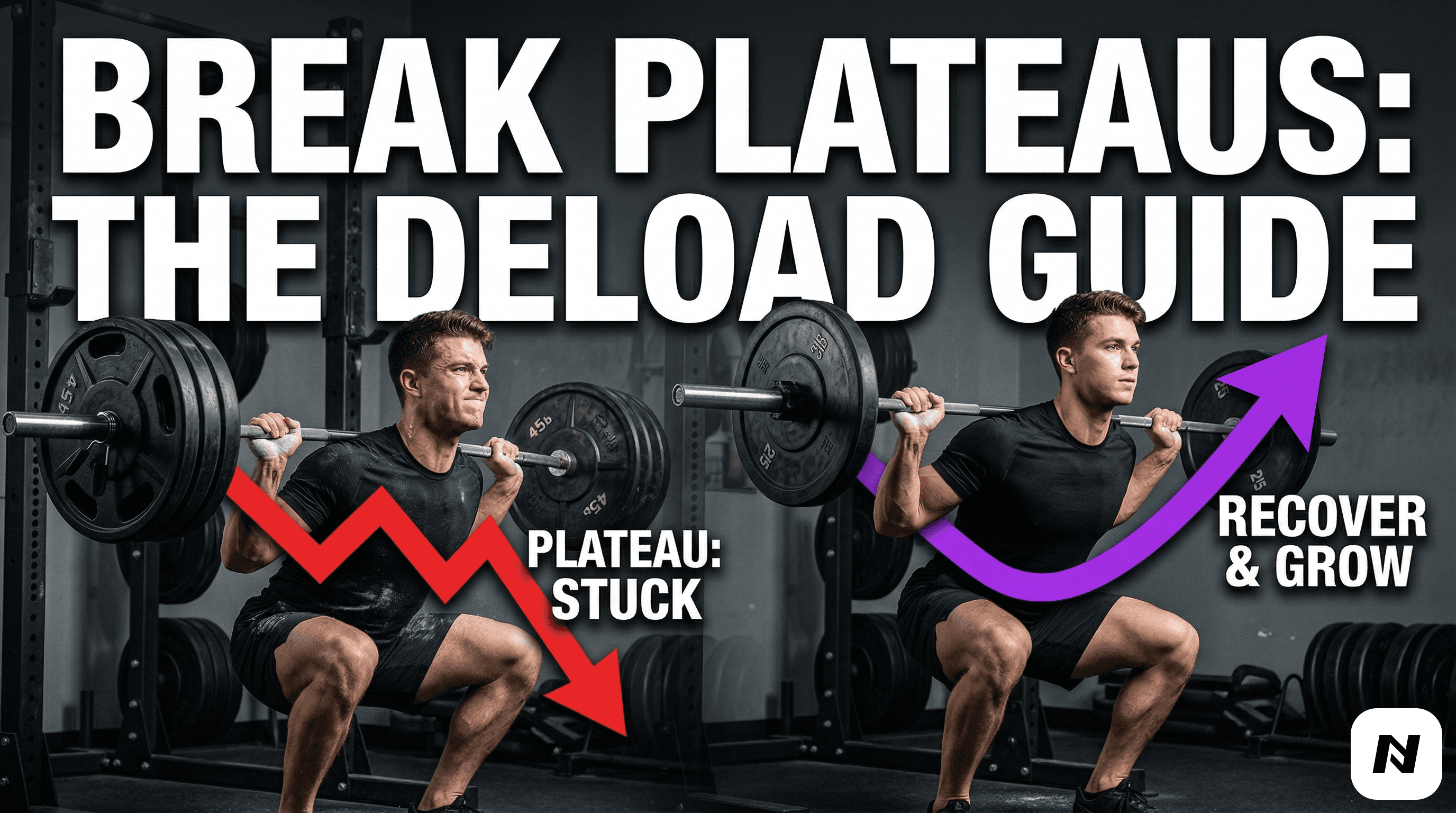
Progressive overload is the most important law of lifting, but it has a limit. You cannot add weight to the bar infinitely. To get stronger, you must occasionally take one step back so you can take three steps forward. Here is exactly when progressive overload stops working, how to identify the signs of fatigue, and how to execute a perfect deload week to force new muscle growth.
The Myth of Infinite Linear Progress
Your body is a biological machine, not a spreadsheet.
When you first start lifting, progress is linear. You add weight every single session. Your nervous system is rapidly learning how to recruit muscle fibers. This beginner phase is incredibly rewarding, but it eventually ends.
As you become stronger, the stress you apply to your body becomes massive. Squatting 135 pounds requires minor recovery. Squatting 315 pounds inflicts significant systemic damage. Your muscles recover in a matter of days, but your central nervous system (CNS), joints, and connective tissues take much longer to heal.
If you continue pushing for progressive overload without resting, the fatigue outpaces your recovery. This leads to a massive biological roadblock.
The Fitness-Fatigue Model
To understand why a deload works, you must understand the fitness-fatigue model.
Every time you lift heavy weights, you generate two things: fitness and fatigue.
Fitness is your actual potential to lift heavy weight and build muscle. It persists for a long time.
Fatigue is the physical exhaustion in your muscles and nervous system. It is temporary, but it is powerful.
Your actual performance on the gym floor is your fitness minus your fatigue.
When you train hard for six or eight weeks in a row, your fitness is very high. You are strong. But your fatigue is also very high. This accumulated fatigue acts like a heavy blanket over your true strength. It masks your fitness.
A deload week strips away the fatigue. Because fatigue dissipates much faster than fitness, taking a week of light training clears the exhaustion while preserving all your muscle and strength. When you return to normal training the following week, the heavy blanket is gone. Your true strength is revealed, and you instantly smash your old plateaus.
5 Clear Signs It Is Time to Deload
Do not guess when to take a break. Your body and your gym notebook will tell you exactly when it is time. Look for these five undeniable signs.
1. Your Progress Charts Flatline
This is the most objective metric. Your memory will lie to you, but your data will not. If you are using a digital gym notebook like Nouta, look at your progress charts.
If your estimated one-rep max or your total weekly volume has been climbing steadily, and then suddenly flatlines—or worse, starts dipping—for two or three consecutive weeks, you are overreached. You cannot out-work a flatlined chart. A visual plateau is the ultimate signal that your body needs a reset.
2. Persistent Joint and Tendon Pain
Muscle soreness (DOMS) is normal. Joint pain is not.
If your elbows ache every time you press, your knees throb when you walk down stairs, or your lower back feels constantly stiff, your connective tissues are begging for mercy. Tendons and ligaments have significantly less blood flow than muscle tissue. They take weeks longer to recover from heavy loading. A deload gives your connective tissues a chance to catch up and heal.
3. The Weights Feel Unusually Heavy
Every lifter knows this feeling. You walk up to the bar to do your normal working weight. You unrack it, and it feels like a house.
This is a symptom of central nervous system fatigue. Your CNS is responsible for firing the electrical signals that tell your muscles to contract. When the CNS is fried from weeks of heavy, high-intensity lifting, it cannot recruit your muscle fibers efficiently. The weight has not changed, but your brain's ability to move it is temporarily compromised.
4. Loss of Grip Strength
Your grip is an incredibly accurate barometer for systemic fatigue. If you normally deadlift 315 pounds with a double-overhand grip, but suddenly the bar is slipping out of your hands at 275 pounds, your nervous system is exhausted. When your grip fails before your target muscles do, it is time to deload.
5. Your Sleep and Mood Deteriorate
Overtraining is not just physical; it is hormonal. Pushing your body past its recovery limits spikes cortisol, your body's primary stress hormone. Elevated cortisol levels ruin your sleep architecture.
If you are exhausted all day but lie awake staring at the ceiling at night, your training volume is likely too high. Furthermore, if you feel a deep sense of dread when you pack your gym bag, or you lose all motivation to train, your brain is actively trying to stop you from accumulating more fatigue.
How to Deload: Two Proven Methods
A deload is not a week off. Sitting on the couch for seven days will actually make you feel sluggish and detrained when you return.
You must go to the gym. You must go through the motions. You just need to reduce the stress.
There are two primary ways to execute a deload. You drop the volume, or you drop the intensity. Both work, but they serve slightly different purposes depending on how you train.
Method 1: The Volume Drop
This is the best method for bodybuilders and people focused primarily on building muscle size (hypertrophy).
Hypertrophy training usually involves moderate weights and high volume (lots of sets and reps). To deload, you keep the weight relatively heavy, but you drastically cut the amount of work you do.
The Rule: Cut your total sets and reps by 40 to 50 percent, but keep the weight the same.
Example:
Normal Week: Squats for 4 sets of 10 reps at 225 pounds.
Deload Week: Squats for 2 sets of 5 reps at 225 pounds.
Why it works: You maintain your familiarity with heavy weights, so your nervous system stays sharp. However, because you are doing half the mechanical work, your muscles undergo almost zero tissue damage. You leave the gym feeling refreshed instead of wrecked.
Method 2: The Intensity Drop
This method is best for powerlifters, strength athletes, and people who train primarily in the 3 to 5 rep range.
Heavy strength training crushes the central nervous system and the joints. To recover, you need to take the heavy loads off your spine and knees.
The Rule: Keep your sets and reps the same, but cut the weight on the bar by 40 to 50 percent.
Example:
Normal Week: Bench Press for 3 sets of 5 reps at 250 pounds.
Deload Week: Bench Press for 3 sets of 5 reps at 135 pounds.
Why it works: The weight feels laughably light. You focus entirely on perfect technique, bar speed, and getting a good stretch. Your joints get a massive break from the heavy compression, and your CNS fully recharges.
Which Method Should You Choose?
Keep it simple. If your joints hurt and you feel physically crushed, drop the intensity (the weight). If you feel generally tired, unmotivated, and your muscles are constantly sore, drop the volume (the sets and reps).
Step-by-Step: Planning Your Deload Week
Executing a deload requires discipline. It requires leaving your ego at the door. Here are the rules for a successful deload week.
1. Do Not Change Your Exercises A deload week is not the time to try a new routine. Do not swap your barbell squats for machine hack squats. Keep your template exactly the same. You want your body to practice the specific motor patterns of your main lifts without accumulating fatigue.
2. Keep Your Frequency the Same If you normally train four days a week, go to the gym four days a week during your deload. Keeping your schedule consistent maintains your gym habit. The sessions will just be much shorter.
3. Avoid Muscular Failure Under no circumstances should you grind out a hard rep during a deload. You should have at least five or six reps in reserve (RIR) at the end of every single set. If your face is turning red, you are doing it wrong.
4. Get In and Get Out Your deload workouts should take about half the time of your normal workouts. Do your prescribed sets, do some light mobility work, and leave. Resist the urge to add extra bicep curls just because you have extra energy. That defeats the entire purpose.
How to Log a Deload Without Ruining Your Data
For people who love tracking their progress, a deload week can cause a psychological hurdle.
When you open your gym notebook and log 135 pounds instead of your usual 225 pounds, your progress charts will show a massive dip. Some lifters hate seeing this downward spike. They worry it ruins their data history or makes it look like they lost strength.
This is where clarity and a good digital tool matter.
When using a free gym notebook like Nouta, you have total control over your logging. Here is how to handle your data during a deload:
Embrace the Dip: The most accurate way to log is to simply record the actual sets, reps, and weights you performed. Yes, your volume chart will drop for one week. Let it drop. When you look back at your charts over six months, those periodic dips are the visual proof that you train intelligently. A perfectly straight, unbroken line pointing upward is a lie. Real progress looks like a staircase: you climb, you plateau, you drop slightly to rest, and then you climb higher than before.
Use the Notes: If you want context for your future self, use the simple logging features to add a note to that specific workout. Just type "Deload Week." Three months from now, when you look back at your history, you will instantly understand why the numbers were lower.
Protecting Your PRs: A proper gym notebook automatically filters your Personal Records. Logging a 135-pound squat during a deload will not overwrite your 315-pound PR. Your true strength benchmarks remain safe and intact, waiting for you to beat them next week.
What Happens After the Deload?
The deload week is over. You feel rested. Your joints do not hurt. You are hungry to lift heavy again.
Do not let your ego ruin the rebound.
When you return to normal training, do not immediately attempt a new one-rep max. Do not jump straight to a weight you have never touched before. Your body is fresh, but it needs a session or two to reacclimate to heavy loads.
The Re-entry Strategy: Look at the numbers you logged in your gym notebook during the week before your deload.
For your first week back, aim to hit those exact same numbers. Lift the same weight for the same reps. Because you are now completely recovered and fatigue-free, those old numbers should feel significantly easier than they did two weeks ago.
Once you confirm your strength is back and feeling light, the progressive overload resumes. The following week, you add weight to the bar. You hit a new PR. You log it. The cycle begins again.
Consistency Requires Rest
You cannot sprint a marathon. Building an impressive physique and elite strength takes years of dedicated work.
If you refuse to deload, your body will eventually force you to take a break through an injury. Taking one planned week of light training every two months is a massive victory for your long-term progress.
Listen to your body. Look at the trends in your app. Check your ego at the door, drop the weight, and recover.
FAQ: Deloading
How often should I take a deload week? Most intermediate and advanced lifters should deload every 6 to 8 weeks. Beginners can often train for 10 to 12 weeks before needing a deload, because they are not yet strong enough to generate massive systemic fatigue.
Will I lose muscle during a deload week? Absolutely not. It takes at least three weeks of complete inactivity to begin losing muscle tissue. Taking one week of light training will only make you stronger by allowing your muscles to fully repair.
Should I eat fewer calories during a deload? No. Keep your nutrition exactly the same, especially your protein intake. Your body needs those calories and nutrients to heal the micro-tears in your muscles and repair your connective tissues.
Can I do intense cardio during a deload? It is best to avoid it. Intense interval training (HIIT) taxes the central nervous system just like heavy lifting. Stick to light, steady-state cardio like walking or easy cycling to promote blood flow without adding fatigue.
Your data holds the truth. Spot your plateaus, plan your deloads, and track your true strength without the clutter.