Workout With Friends Motivation: How Rivalry Builds Muscle
Discover the science of workout with friends motivation. Learn how friendly competition and tracking shared PRs directly force you to build more muscle.
·
Version
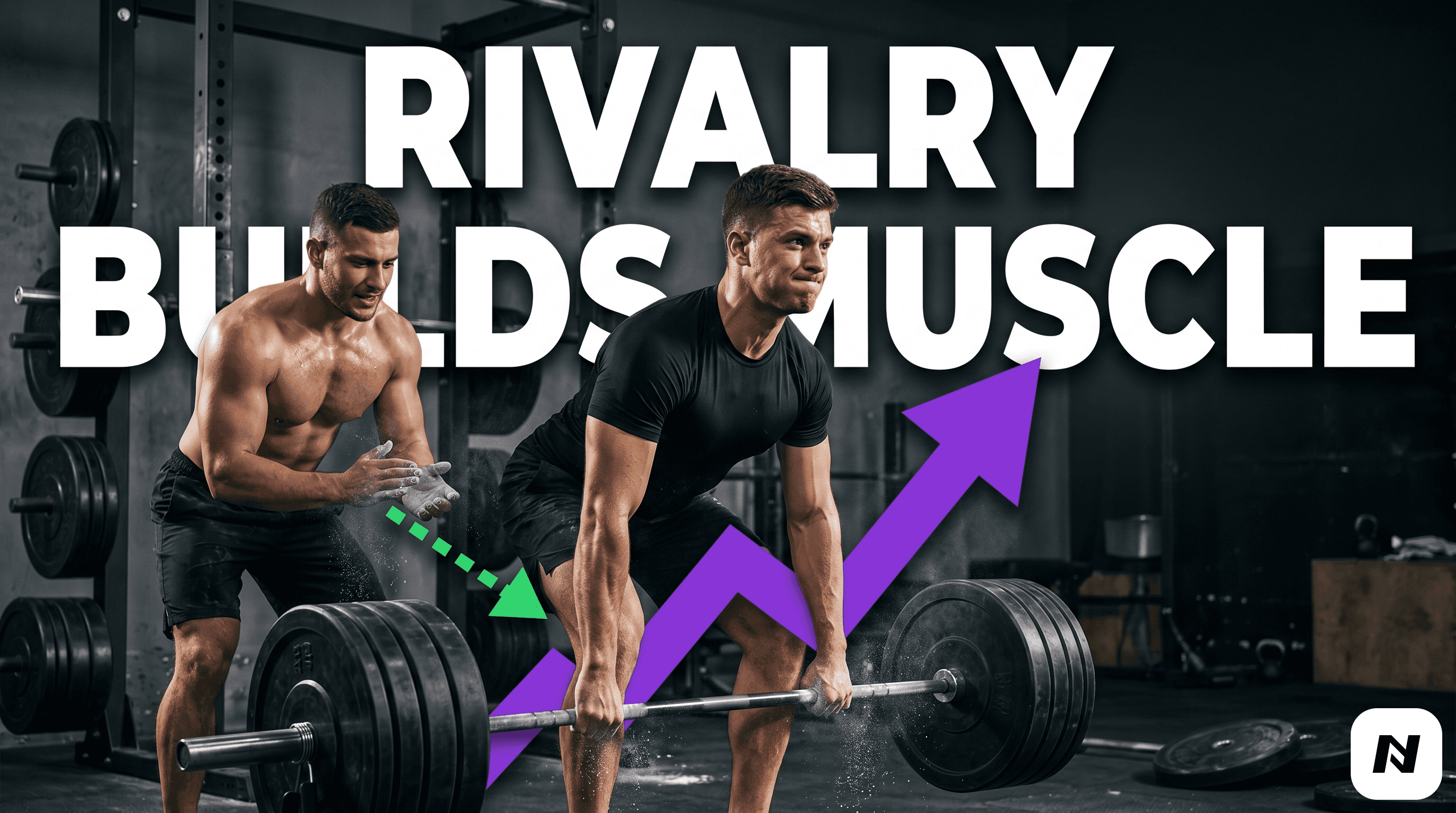
How Friendly Competition Actually Builds Muscle
Lifting weights often feels like a solitary pursuit. It is just you, the barbell, and gravity. You put on your headphones, block out the room, and get to work.
But true isolation has a ceiling.
If you train completely alone for long enough, you will eventually stall. You will settle into a comfortable rhythm. You will stop adding that extra five pounds to the bar because your brain tells you it is too heavy. You lose your edge.
This is where your training partners come in. The right environment changes your physical output. Seeing a friend load up a heavy barbell and successfully lift it does not just inspire you. It physically primes your body to work harder.
Finding your "workout with friends motivation" is not about high-fives and matching gym outfits. It is about data. It is about rivalry. It is about the deeply rooted psychological need to keep up with the pack.
Here is exactly how friendly competition overrides your limits, forces you to break plateaus, and translates directly into new muscle growth.
The Psychology of Workout With Friends Motivation
Your brain is designed to protect you from exertion. When a set of heavy squats gets difficult, your central nervous system screams at you to stop. It tells you that you have nothing left.
Most of the time, this is a lie. You usually have two or three more reps in the tank. But accessing those final, muscle-building reps requires an external trigger.
The Köhler Effect
In psychology, there is a phenomenon known as the Köhler Effect. It states that individuals work harder when they are part of a group than when they are alone. More importantly, it shows that no one wants to be the weakest link.
When you train with someone who is slightly stronger than you, or matched at your exact level, your baseline for what is "acceptable" shifts. If you plan to stop at eight reps, but your training partner grinds out ten, your brain instantly recalibrates. You unrack the bar for your next set, and suddenly, eight reps is no longer the goal. Ten is the standard. You push past your perceived limits simply because someone else proved it was possible.
Adrenaline and the Nervous System
Motivation is not just a feeling. It is a chemical reaction.
Watching a friend attempt a massive Personal Record (PR) triggers an adrenaline spike in your own body. Your heart rate elevates. Your nervous system wakes up. This sympathetic nervous system arousal physically prepares your muscle fibers to contract with more force. You borrow their hype. When you step up to the bar immediately after them, you are neurologically primed to lift heavier weight than you could have on your own.
Why Hard Data Changes Your Mindset
Abstract goals do not build muscle. Telling yourself "I want to get stronger this year" is useless.
Strength requires specific targets. You need concrete numbers. This is why having a competitive training partner is so effective. Their success provides you with hard data.
Tangible Targets Over Wishful Thinking
Imagine your goal is to bench press 225 pounds. It feels like a massive, insurmountable wall.
Then, your friend—who eats the same food as you, sleeps the same amount as you, and trains on the same days as you—hits 225 pounds for a clean triple. The wall shatters. The goal is no longer abstract. It is a reality, demonstrated by someone with the same capabilities as you.
Their hard data becomes your blueprint. You know exactly what it takes. You stop wondering if you can do it, and you start calculating the exact weight jumps you need to match them.
The Power of the "Next Set" Intensity
This dynamic does not just apply to lifetime PRs. It applies to everyday working sets.
If your digital gym notebook says you should lift 185 pounds for 8 reps, but your friend just logged 185 pounds for 10 reps, your intensity for the next set instantly spikes. You grip the bar tighter. You brace your core harder. The friendly rivalry forces you to squeeze out maximum effort on a random Tuesday night.
Those extra two reps, driven entirely by competition, are exactly what force the muscle to adapt and grow.
Breaking Plateaus Through Rivalry
Every lifter hits a plateau. You spend weeks lifting the same weight for the same number of reps. Your body has adapted to the stress, and it refuses to change further.
Breaking a plateau requires a shock to the system. You have to force the muscle to do something it has never done before.
When you train alone, it is incredibly hard to manufacture that shock. You talk yourself out of adding weight. You convince yourself that the current load is "enough for today."
A competitive friend removes your excuses. They add the 2.5-pound plates to the side of your bar before you can object. They tell you to stop overthinking and just unrack the weight. They spot you safely, removing the fear of failure.
This external push is the ultimate plateau breaker. Rivalry overrides your natural desire for comfort.
Digital Accountability: Competition Without Schedules
There is only one problem with the "training partner" model. Life gets in the way.
You work late. They have a morning commute. Coordinating schedules so you can train at the exact same time, on the exact same rack, is practically impossible for most adults.
But you do not need to be in the same room to leverage workout with friends motivation. You just need to be in the same network. You need a digital gym logbook that keeps the rivalry alive, regardless of what time you actually touch the barbell.
This is where Nouta bridges the gap.
The Social Feed for Lifters
Nouta is built on the understanding that community drives progress. It features a streamlined, distraction-free friends feed.
When your training partner finishes their 6 AM workout, they log their sets. When you open the app for your 6 PM workout, their data is waiting for you. You see their numbers. You see their completed volume. If they hit a massive milestone, you see the digital PR confetti on your screen.
You are instantly connected to their effort. You now have a target for your evening session. They set the pace; it is your job to match it.
Shared PRs and Progress Charts
Trash talk in a group chat is fun, but data ends the debate.
Nouta tracks your progress charts and PRs automatically. There is no manual math. You can clearly see the trajectory of your own strength compared to your friends. If your squat chart is flatlining while your buddy’s chart is trending upward, you know immediately that you need to adjust your programming and push harder.
The shared data turns friendly banter into a measurable race. It keeps you accountable on the days you want to skip the gym. You know that if you miss a session, your friends will see the gap in your log.
Simple Logging Keeps You Focused
Most fitness apps ruin the social experience by cluttering your screen with ads, complex avatars, and unnecessary metrics.
Nouta keeps it simple. The app utilizes a true dark mode that is easy on the eyes and fits the gritty atmosphere of a real gym. The simple logging interface takes seconds to use. You tap your weight, you tap your reps, and you get off your phone.
You spend less time staring at a screen and more time focusing on beating your friend's latest record.
Share the Load, Amplify the Gains
You can absolutely build an impressive physique on your own. But if you want to find out what you are truly capable of, you need someone pushing you from behind.
Friendly rivalry exposes your weak points. It forces you to lift with more intent. It takes the heavy, repetitive nature of weightlifting and turns it into a game you actively want to win.
Stop keeping your numbers a secret. Start competing.
FAQ: Training With Friends
What if my friend is much stronger than me? Competition does not require identical strength levels. If your friend squats 400 lbs and you squat 200 lbs, you do not compete on absolute weight. You compete on relative effort. Track your volume, compare your consistency, or race to see who can add 10 pounds to their respective PR first.
Is it safe to push harder just because of competition? Always prioritize form over ego. Friendly competition should encourage you to try harder on weights you can safely manage. If a weight causes your form to break down completely, swallow your pride, rack the bar, and live to lift another day. Always use a spotter for heavy attempts.
How do we stay motivated if we cannot train together? Use a shared digital gym notebook. Log your sets, track your PRs, and check your friend's feed before you start your own workout. Seeing their logged numbers is often enough to trigger the competitive mindset, even if you are hours apart.
Turn your goals into a competition. Track your exact numbers, see your friends' PRs, and push past your plateaus together.
Download Nouta for free today.