Create a Custom Workout Routine That Actually Works
Learn how to create a custom workout routine from scratch. Step-by-step guide on picking splits, selecting exercises, and building digital templates.
·
Version
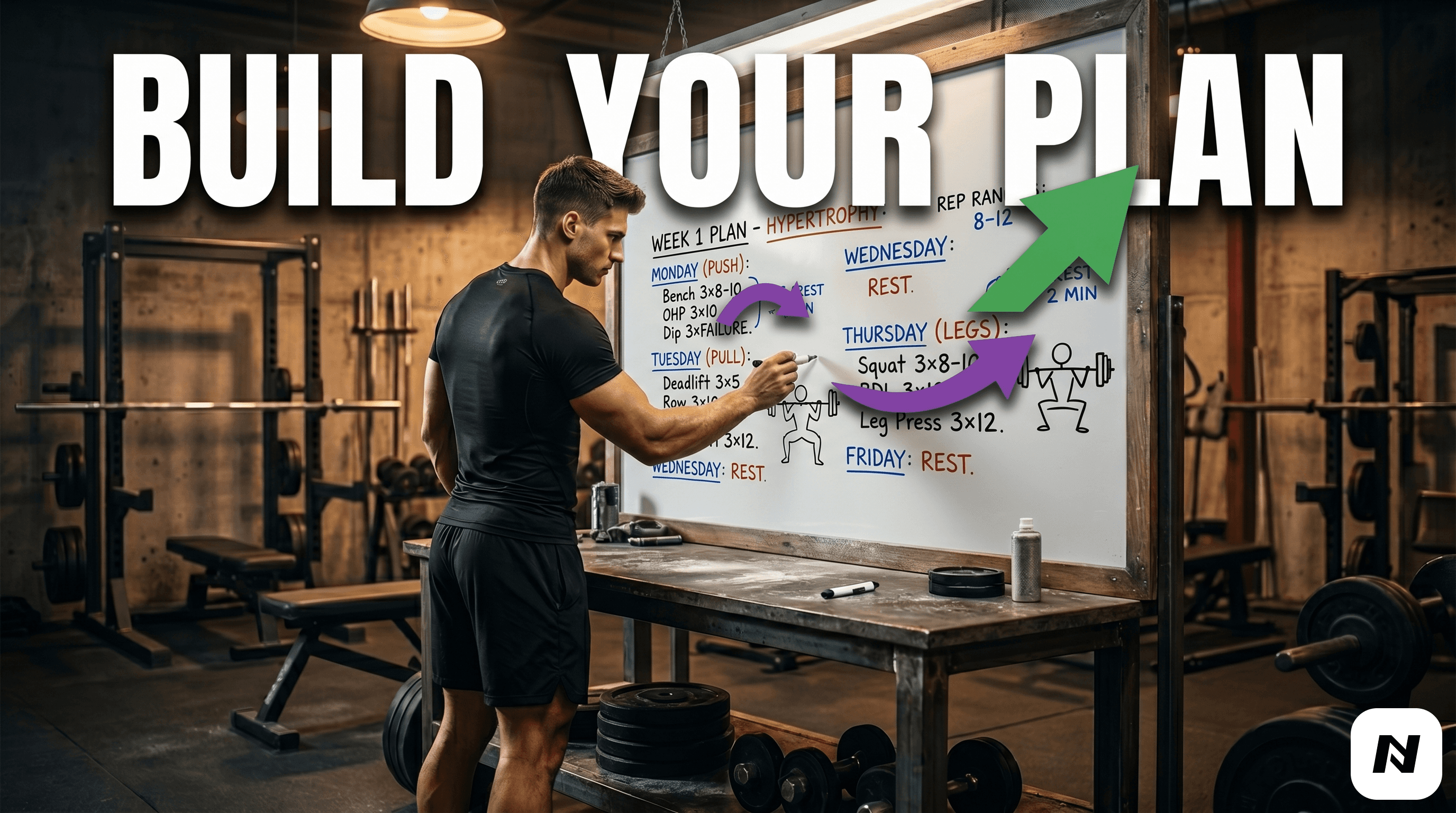
How to Create a Custom Workout Routine (And Stick to It)
Walking into the gym without a plan is a guaranteed way to waste your time.
You wander between machines. You do a few sets of bicep curls. You try the bench press because it is empty. You leave an hour later feeling tired, but you have not actually stimulated any meaningful muscle growth.
To build muscle and gain strength, you need structure. You need a program that forces your body to adapt. But buying a generic, rigid PDF program from a fitness influencer is rarely the answer. Those programs do not care about your schedule, your specific gym equipment, or your current fitness level.
The better option is to build your own.
When you create a custom workout routine, you take control of your progress. You design a system that fits your life. You pick the exercises that feel best for your joints. And most importantly, you understand the why behind your training.
This guide will show you exactly how to design a personalized gym routine from scratch. We will cover how to pick your split, choose the right exercises, set your rep ranges, and build a reusable digital template you can take to the gym today.
Why You Need a Personalized Plan
Generic programs fail because they are inflexible.
If a paid program demands heavy barbell squats on a Tuesday, but your gym only has one squat rack that is always occupied, you are stuck. You lose momentum.
When you create a custom workout routine, you build a flexible framework.
It fits your schedule: If you can only train three days a week, your custom plan reflects that. You do not feel guilty for missing "Day 4" of a generic program.
It respects your biomechanics: Not everyone can barbell bench press without shoulder pain. A custom routine lets you easily swap it for dumbbell presses.
It focuses on your goals: You decide if you want to prioritize heavy strength training or higher-volume muscle building.
A custom routine is not about guessing. It is about applying basic strength training principles to your specific situation.
Step 1: Define Your Schedule and Split
Consistency beats intensity every single time.
Do not plan a six-day-a-week routine if you have a demanding job and a busy family life. You will miss a day, feel defeated, and quit. Be honest about how many days you can realistically train every week for the next six months.
Once you know your days, you pick your "split." A split is simply how you divide your muscle groups across the week.
Training 3 Days a Week: The Full Body Split
If you train three days a week, do full-body workouts. You hit every major muscle group in a single session. This ensures each muscle gets stimulated multiple times a week, which is crucial for beginners.
Example Schedule: Monday (Workout A), Wednesday (Workout B), Friday (Workout A).
Training 4 Days a Week: The Upper/Lower Split
If you have four days, split your body in half. You dedicate two days to your upper body (chest, back, shoulders, arms) and two days to your lower body (quads, hamstrings, glutes, calves).
Example Schedule: Monday (Upper), Tuesday (Lower), Thursday (Upper), Friday (Lower).
Training 5 or 6 Days a Week: The Push/Pull/Legs Split (PPL)
This is the gold standard for high frequency. You divide your body by movement patterns. Push days handle the chest, shoulders, and triceps. Pull days handle the back and biceps. Leg days handle the lower body.
Example Schedule: Push, Pull, Legs, Rest, Repeat.
Pick the split that fits your life. Do not overcomplicate it.
Step 2: Master the Core Movement Patterns
When you create a custom workout routine, do not think in terms of "muscles." Think in terms of "movements."
If you try to pick an exercise for every single tiny muscle, your routine will take three hours. Instead, focus on compound exercises. These are movements that use multiple joints and muscle groups at the same time. They give you the highest return on your time investment.
Every good custom routine is built around these primary movement patterns:
1. The Squat Pattern (Knee Dominant)
This builds your quads and glutes.
Examples: Barbell Back Squats, Front Squats, Hack Squats, Leg Press, Bulgarian Split Squats.
2. The Hinge Pattern (Hip Dominant)
This builds your posterior chain (hamstrings, glutes, lower back).
Examples: Deadlifts, Romanian Deadlifts (RDLs), Kettlebell Swings, Glute Bridges.
3. The Horizontal Push
This builds the thickness of your chest, front shoulders, and triceps.
Examples: Flat Bench Press, Incline Dumbbell Press, Machine Chest Press, Push-Ups.
4. The Horizontal Pull
This builds the thickness of your mid-back and lats.
Examples: Barbell Rows, Seated Cable Rows, T-Bar Rows, Dumbbell Rows.
5. The Vertical Push
This builds your shoulder caps.
Examples: Overhead Barbell Press, Seated Dumbbell Press, Machine Shoulder Press.
6. The Vertical Pull
This builds the width of your back.
Examples: Pull-Ups, Chin-Ups, Lat Pulldowns.
Your goal is to select one or two exercises from each category to form the foundation of your routine. After you cover the big compound movements, you can add "isolation" exercises at the end of your workout. Isolation exercises target a single joint (like Bicep Curls, Tricep Extensions, or Calf Raises).
Step 3: Determine Sets, Reps, and Rest
Now that you have your exercises, you need to assign the numbers.
Sets (How many rounds?)
A set is a group of consecutive repetitions. For beginners, aiming for 10 to 15 total "working sets" per muscle group per week is ideal. If you do full-body workouts three times a week, doing 3 to 4 sets per exercise per session easily hits this goal. Keep it simple: Do 3 working sets for most exercises.
Reps (How many lifts per round?)
Your rep range determines your primary adaptation.
1 to 5 reps: Pure strength. Use heavy weights. Best for your first big compound lift of the day (like the Squat or Bench Press).
6 to 12 reps: Muscle hypertrophy (growth). Use moderate weights. Best for the majority of your exercises.
12 to 20 reps: Muscular endurance and isolation work. Best for small muscles like calves, side delts, or biceps.
Rest (How long between sets?)
Do not rush. If you are breathing heavily, your next set will suffer.
Heavy compound lifts: Rest 2 to 3 minutes.
Moderate isolation lifts: Rest 60 to 90 seconds.
Step 4: Build Your Routine in a Gym Notebook
Writing your routine on a scrap of paper is a recipe for failure. Paper gets lost. It gets covered in sweat. And most importantly, paper cannot calculate your progress.
To actually execute the program you just designed, you need a digital gym notebook.
This is where Nouta comes in. Nouta is a free app built specifically for lifters who want to log their workouts without dealing with complex, cluttered interfaces or annoying paywalls. It runs entirely in dark mode, saving your phone battery and your eyes under the bright gym lights.
Here is how you digitize your plan using Nouta's templates feature:
1. Create a New Template
Open Nouta and navigate to the templates section. Tap "Create New." Name it based on your split (e.g., "Full Body A" or "Push Day").
2. Add Your Chosen Exercises
Search the exercise database and add the movements you selected in Step 2. Arrange them in order. Always put your heaviest, most taxing compound lifts at the beginning of the template. Put your isolation exercises at the end.
3. Set Your Targets
Assign your target sets and reps directly in the template. This becomes your baseline.
4. Save and Execute
When you walk into the gym, you do not need to think. You open Nouta, tap your custom template, and start lifting. The app pre-loads your entire routine. All you have to do is input the actual weight you lifted.
By building a template, you eliminate decision fatigue. You know exactly what you are doing the moment you step onto the gym floor.
Step 5: How to Actually Stick to Your Plan
Designing the program is only 10% of the battle. The other 90% is executing it consistently. Here are the three rules for sticking to your custom routine.
Rule 1: Master Progressive Overload
Doing the exact same workout with the exact same weight every week will not change your body. Your muscles only grow when they are forced to adapt to a new, harder stimulus. This is called progressive overload.
Every time you perform your custom routine, you must try to beat your last session. You can do this by:
Adding 5 lbs to the bar.
Doing one more repetition with the same weight.
Completing the same work with slightly better form.
When you use Nouta, progressive overload is tracked automatically. When you open your template, the app shows you exactly what weight and reps you hit last week. You do not have to rely on your memory. You simply look at the screen, see that you lifted 135 lbs for 8 reps last week, and aim for 9 reps today.
Rule 2: Embrace the Boring
A good custom routine is boring. It does not change every week.
Many beginners make the mistake of changing their exercises constantly because they want to "confuse the muscles." Muscle confusion is a myth. The only thing you confuse is your ability to track progress.
Stick to the exact same custom routine for at least 8 to 12 weeks. Master the movements. Drive your numbers up. Only change an exercise if it causes pain or if your progress has completely stalled for weeks.
Rule 3: Use Social Accountability
Lifting alone can be isolating. When you lack motivation, having a crew to keep you accountable can save your session.
You do not need to broadcast your workouts to the entire internet, but sharing your progress with a few close friends creates positive pressure. Nouta includes built-in friends and social features. You can add your training partners, see when they hit the gym, and celebrate their PRs (Personal Records).
Even better, Nouta allows you to share and copy workouts. If you design an incredible 4-day Upper/Lower split, you can send that exact template to your friend. They can copy it directly into their own Nouta app with one tap. You are now both running the same program, comparing numbers, and holding each other accountable.
Example Custom Routine: The Beginner Full-Body Split
If you want a starting point, here is a highly effective, 3-day full-body routine. You alternate between Workout A and Workout B (e.g., Monday: A, Wednesday: B, Friday: A).
Workout A:
Barbell Squats (Squat Pattern): 3 sets of 5-8 reps
Flat Bench Press (Horizontal Push): 3 sets of 8-10 reps
Barbell Rows (Horizontal Pull): 3 sets of 8-10 reps
Dumbbell Lateral Raises (Isolation): 3 sets of 12-15 reps
Tricep Pushdowns (Isolation): 3 sets of 12-15 reps
Workout B:
Romanian Deadlifts (Hinge Pattern): 3 sets of 8-10 reps
Overhead Barbell Press (Vertical Push): 3 sets of 8-10 reps
Lat Pulldowns (Vertical Pull): 3 sets of 8-12 reps
Leg Press (Squat Pattern): 3 sets of 10-12 reps
Bicep Curls (Isolation): 3 sets of 12-15 reps
Take this structure, adjust the exercises if necessary, and build it as two separate templates in your gym notebook.
FAQs About Custom Workout Routines
How long should my workout last? If you are resting properly and pushing yourself, a custom routine should take between 45 and 75 minutes. If you are in the gym for two hours, you are either resting too long or doing too many unnecessary exercises.
Should I lift weights before or after cardio? Always lift weights first. Strength training requires maximum central nervous system output. If you exhaust yourself on the treadmill, your lifts will suffer, and your risk of injury increases. Save the cardio for after you lift, or do it on a separate day.
What if I miss a day? Do not panic and do not try to squeeze two workouts into one. Simply pick up where you left off. The beauty of a custom digital template is that the app does not judge you. Your next workout is ready whenever you are.
How do I know when it is time to change my routine? Keep running your routine as long as you are getting stronger. If you have eaten enough, slept enough, and still have not been able to add weight or reps to your lifts for three consecutive weeks, you have hit a plateau. At that point, you can adjust your templates by changing rep ranges or swapping out a stalled exercise.
Take Control of Your Training
You do not need to buy an expensive PDF to see results in the gym. By understanding basic movement patterns, selecting the right split for your schedule, and tracking progressive overload, you can create a custom workout routine that outperforms any generic plan.
The secret is structure and consistency.
Stop relying on memory or messy paper logs. Build your templates, track your progress automatically, and connect with other lifters who hold you to a higher standard.
Stop winging it.
Download Nouta for free today and start building your custom routine.